
NYC Revolving Doors
- Home
- Door Services
- Revolving Doors
Revolving Door Installation & Repair in NYC
Commercial Entry Systems Serviced Since 1984
For businesses that rely on a revolving door for customer and employee access, keeping the door maintained and operating safely is essential. With over 40 years of experience servicing and repairing revolving doors, Golden Key Locksmith NYC can help restore your door, replace worn parts, and plan a new installation.
We troubleshoot misaligned center shafts, scraping wings, pivot bearings, speed-control issues, sensors, weatherstripping, and collapsing wing adjustments — then verify safe, code-aware operation before we leave.
Call (212) 204-1655 to schedule revolving door service or request a consultation.
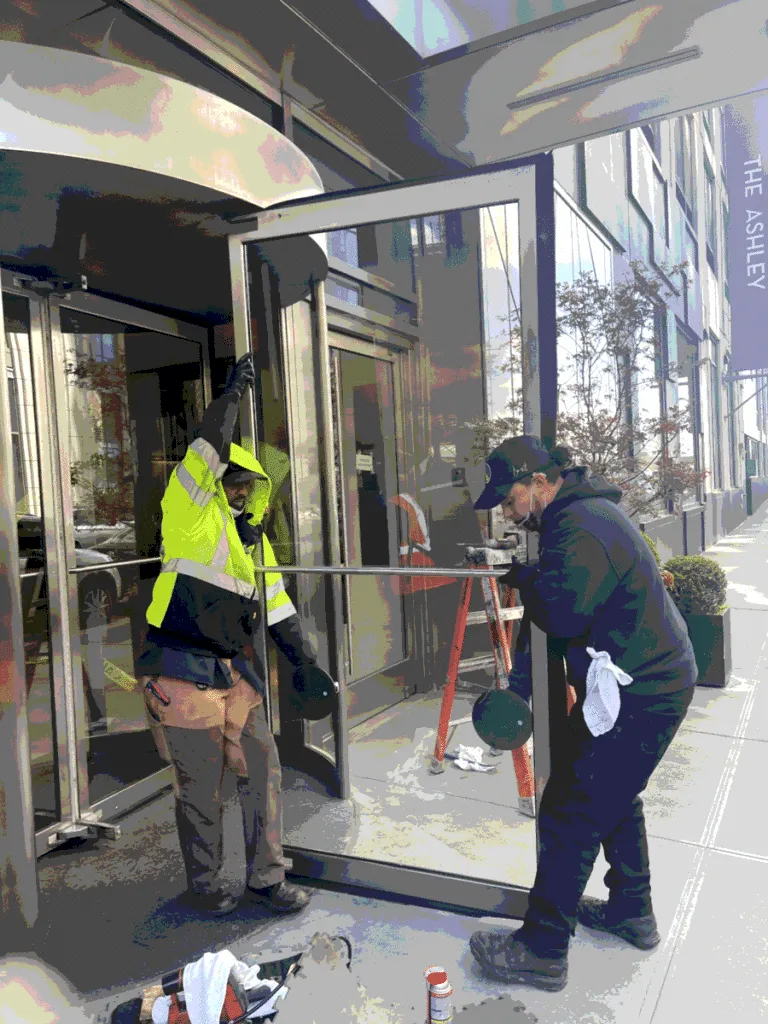
Revolving Door Services
- New revolving door installation
- Emergency repair and troubleshooting
- Replacement of worn assemblies
- Preventive maintenance and adjustments
NYC Revolving Door Services
Revolving Door Installation
New revolving door installation for commercial entries, offices, hotels, and high-traffic NYC buildings.
Revolving Door Repair
Troubleshooting for scraping wings, speed control issues, pivots, bearings, sensors, and worn hardware.
Revolving Door Replacement
Replace worn or outdated revolving door systems with secure and efficient entry solutions.
Revolving Door Maintenance
Maintenance for seals, tracks, bearings, collapsible wings, weatherstripping, and code-aware operation.
Commercial Revolving Door Service for NYC Buildings
Revolving doors are high-traffic mechanical systems — when a wing scrapes, the door speeds up or slows unpredictably, or the collapsible wing will not reseat, the problem is usually bearings, speed control, pivot alignment, or worn weatherstripping rather than the glass itself. Our first step is to diagnose whether the smart fix is adjustment and parts replacement or a full assembly swap, and we tell you which before we start.
Common revolving door problems. We repair misaligned center shafts, scraping or dragging wings, failed pivot bearings, speed-control drift, sensor and safety-device faults, and weatherstripping that no longer seals. Regular inspection, dry lubrication, track cleaning, and speed checks help prevent emergency shutdowns during business hours.
Installation and replacement. New revolving doors must match your traffic pattern, vestibule size, and NYC code requirements. We install and replace commercial revolving systems for offices, hotels, retail entries, and condo buildings, coordinating hardware, closers, and safety sensors as part of the assembly.
Related door work. Many revolving-door calls sit alongside broader door repair and installation or commercial door service. If your entry also includes glass storefront doors, fire-rated assemblies, or automatic operators, we can address those on the same project.
Where we work. We service revolving doors across Manhattan, Brooklyn, Queens, and The Bronx. Call (212) 204-1655 for service scheduling or after-hours help when a door is stuck open or unsafe to operate.
Revolving door repair and maintenance for property managers
Most of our revolving door work comes from building managers, co-op and condo boards, resident managers and commercial tenants who need one contact for the entrance. We diagnose first, tell you whether the fix is an adjustment, a part or a full assembly before we start, and leave a written note of what we found — the same record you can hand to the board or the insurer.
Common faults we repair
- Speed control. A door that spins too fast, hunts between speeds or does not slow when pushed hard usually has a worn or mis-set speed governor or brake in the canopy. It is a safety item as well as a comfort one.
- Wing alignment. Wings that scrape the drum, drag on the floor or leave uneven gaps point to a shifted center shaft, loose wing brackets or a worn top pivot.
- Floor pivot and bearing wear. Grinding, wobble at the center shaft or a door that has visibly dropped means the floor pivot or canopy bearings are worn. Left alone, this wears the wings and the drum too.
- Weather sweeps and seals. Worn rubber sweeps on the wing edges, floor and ceiling let conditioned air out and drafts in; the lobby feels it before the door shows it.
- Breakout (collapsing) hardware. Wings must fold under the required push for emergency egress and reseat properly afterwards. Wings that will not reseat, or that release too easily or too hard, need attention straight away.
- Locks and after-hours security. Floor and ceiling locks, electromechanical bolts and access-control-linked locks each fail differently; our guide to revolving door locking mechanisms explains the options.
- Sensors and operators. On powered doors, sensor faults and operator problems overlap with our automatic door service, and we handle both on one call.
Repair or replace
Repair is the right answer when the drum, canopy and structure are sound and parts are still supportable — bearings, pivots, sweeps, speed control, breakout hardware and locks are all replaceable. Replacement makes sense when the drum or frame is damaged, parts for the unit are no longer available, repairs have become a pattern, or the entrance no longer fits the building’s traffic, accessibility or security needs. We put the two options side by side so the board can decide with the facts in front of it.
Maintenance agreements
A scheduled maintenance agreement is how most managed buildings keep a revolving door out of the emergency column. We set the visit interval to the door’s traffic and age rather than a fixed calendar. Each visit checks and logs speed, breakout force, pivot and bearing condition, lubrication, wing alignment and clearances, sweeps and seals, fasteners, glass and wing edges, and the locking hardware, and we note anything that is wearing so it can be planned rather than discovered. The building gets a service log for its records, and small adjustments happen during the visit rather than as a separate call.
The adjacent ADA swing door
Under the ADA Standards a revolving door is not an accessible route, so the swing door beside it has to be in working order for the entrance to be compliant. We check it on the same visit: closer force and closing speed, clear opening width, hardware that can be operated without tight grasping, and the operator and sensors if it is powered. If your entrance has an automatic swing or slide door alongside the revolving unit, our automatic doors page covers what that side of the vestibule involves.
Guides mentioned above
Planning a new revolving door entrance
Many of the revolving door faults we repair trace back to how the entrance was planned and set: a floor that was never level, a drum sized for lighter traffic than the building now sees, or access control added years after the door went in. If you are adding a revolving door or replacing an old one, these are the decisions that shape how it runs afterward.
Is a revolving door the right fit
A revolving door earns its floor space where traffic is steady and the lobby has to be protected from weather. In tall buildings it also limits the stack effect, where warm air rising through the building pulls street air in at the lobby every time a swing door opens. Typical fits:
- Office towers and multi-tenant commercial buildings with morning and evening rushes
- Hotels, hospitals and medical buildings where lobby temperature and airflow matter around the clock
- Doorman condo and co-op lobbies with constant foot traffic
- Large retail entrances on busy avenues
It is usually the wrong choice for a shallow vestibule, light traffic, or an entrance where carts, freight and strollers move all day. Those openings are better served by a well-fitted swing or sliding door; our commercial doors page covers those options.
Size, wings and drive
Drum diameter and wing count decide how many people fit in each compartment and how fast the door can safely turn. Three wings give larger compartments for luggage and strollers; four wings give smaller compartments and suit a steady stream of people walking singly. A larger diameter allows wider compartments but needs more clear floor depth inside and outside the drum.
Manual doors are simple and dependable for moderate traffic, with a speed control that limits how fast the door turns when someone pushes hard. Automatic doors start when someone approaches, hold a set speed, and slow or stop when a sensor or safety edge detects contact. They handle heavy traffic better and are easier for older visitors and anyone carrying something, but they add a drive, controller and sensors that need power and periodic adjustment.
What the site survey checks
- Floor level and structure under the drum, because the floor pivot carries the wings and an uneven floor shows up later as scraping and uneven gaps
- Ceiling height and canopy space for the speed control, drive and any ceiling lock
- Clear depth inside and outside the drum, so people are not queuing onto the sidewalk or into the lobby desk
- Power and low-voltage runs for automatic drives, sensors, card readers and any fire alarm connection
- Where the required side-hinged swing door goes, and how the breakout wings fold into a clear exit path
- Floor mats, thresholds and finishes that affect wing clearance at the floor
Access control and after-hours lockdown
Because each compartment holds one person or a small group, a revolving door makes it harder for someone to follow a tenant in on one badge than a swing door does. If the building uses key cards, fobs or a staffed lobby desk, plan the reader locations, the electric lock and the cabling before installation so nothing has to be surface-mounted later. Decide at the same stage how the door is secured at night, whether with floor and ceiling bolts or an electromechanical lock tied to the access control system, and how that lock releases in an emergency.
Daily care between service visits
Building staff can prevent a lot of wear with a few habits:
- Keep the floor ring and threshold clear of salt, sand and grit, especially in winter, when grit works its way into the floor pivot
- Do not spray heavy oil or penetrating lubricant on the pivots; it collects street grime and gums up the mechanism. Leave lubrication to the service visit, which uses a dry lubricant
- Wipe dust off sensor lenses and safety edges on automatic doors, since dirt can cause false stops
- Listen for new noises, note when a wing starts to drag, and report it before it turns into a shutdown
Revolving Door Guides & Related Services
Read revolving-door guides and related commercial door resources from Golden Key Locksmith NYC.
Frequently Asked Questions
Common questions about revolving door repair, maintenance, and service areas in NYC.
What are the warning signs that a revolving door needs service?
Scraping or dragging wings, uneven or changing speed, unusual noise, loose seals, sensor faults, resistance, or an entrance that will not secure are all reasons to schedule service. Small changes in alignment or speed are easier to address before the entrance must be taken out of operation.
How often should a revolving door be maintained?
There is no single interval for every entrance. Traffic, age, weather exposure, system type, prior repairs, and manufacturer guidance determine the schedule. Preventive service typically checks alignment, pivots or bearings, speed control, safety devices, tracks, wings, seals, and overall operation.
Can a revolving door be repaired, or does it need replacement?
Many recurring problems can be repaired through alignment, bearing or pivot service, speed-control adjustment, sensor work, seals, or component replacement. A new system may be appropriate when the structure or major mechanisms are beyond safe service, parts are no longer supportable, or the entrance no longer fits the building’s traffic, accessibility, or security needs.
What should we do if the revolving door is stuck or unsafe?
Stop using it and keep people away from the affected entrance until it can be assessed. Do not force the wings or bypass a safety device. Golden Key handles urgent commercial troubleshooting and can advise how to secure or route around the entrance while service is arranged.
Why use Golden Key for revolving-door service in NYC?
Golden Key has serviced NYC commercial entrances since 1984. We work on the revolving-door components as well as the surrounding glass, locks, closers, access control, and related entry hardware, giving property managers one team for diagnosis, repair, maintenance, and replacement planning.
Do you offer scheduled maintenance agreements for revolving doors?
Yes. We set the visit interval to the door’s traffic and age. Each visit checks and logs speed control, breakout force, pivots and bearings, lubrication, wing alignment and clearances, weather sweeps and seals, fasteners, glass and wing edges, and the locking hardware, and includes the adjacent ADA swing door. Small adjustments are done during the visit; anything larger is written up and quoted before work so the building can plan it.
Saving Your Time & Money With Reliable Door Service
Golden Key Locksmith NYC provides comprehensive door and security solutions for commercial customers since 1984. We are a fully licensed, bonded, and insured company, with revolving door specialists available for scheduled service and urgent repairs.
The Perfect Solution For All NYC Door Services
The team at Golden Key Locksmith NYC services revolving doors, commercial entries, and building security across NYC. Whether you need preventive maintenance, an emergency repair, or a new installation, we can help — call today to schedule revolving door service.
- 40 Years Experience
- Client Satisfaction Guaranteed
Request a Quote
Tell us what you need — name, number, ZIP, and a few details — and Golden Key Locksmith NYC will get right back to you.
- 328 Columbus Ave New York, NY 10023
-
Mon–Fri 8:30am–5pm (Showroom Hours)
Emergency Service: 24/7 - (212) 204-1655
We Are Trusted Over 40 Years
Golden Key Locksmith NYC has serviced revolving doors and commercial entries across New York City for over 40 years.