

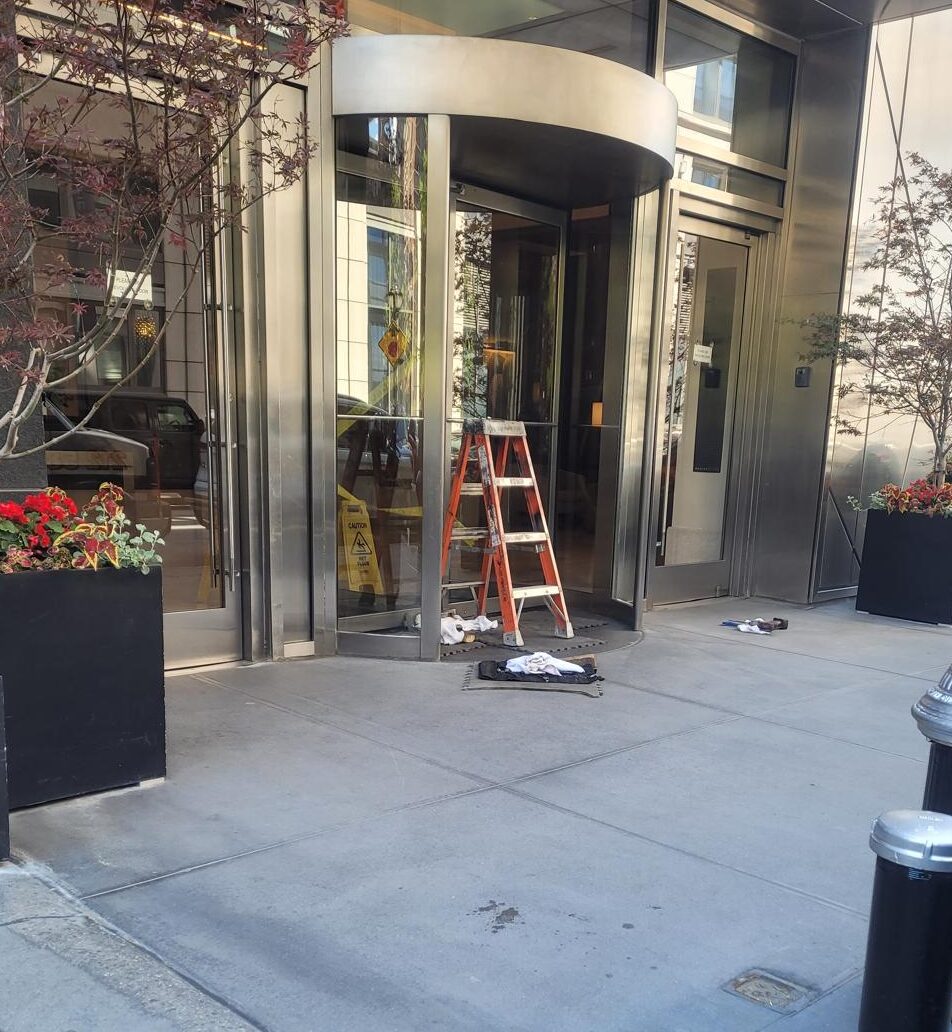
Anyone who has stood in the lobby of a busy Midtown office tower at 9 a.m. knows the problem with a standard swing door. People pile up, the door slams open and shut, and a blast of cold or hot air pours in every time somebody walks through. Revolving doors exist precisely to fix that. They move a steady stream of people in and out without ever leaving the building wide open, which is why almost every high-rise, hotel, hospital, and busy retail flagship in New York uses one. Here is how they actually improve traffic flow, and what to think about if you are planning an install or replacement for your building.
Key Takeaways
- Steady flow beats stop-and-go: A revolving door keeps people moving through the entrance continuously instead of bunching up behind a swing door, which is what makes it the standard for high-traffic NYC lobbies.
- The door is always closed: Because one wing is always sealing the opening, you lose far less heated or cooled air, which cuts HVAC load in buildings that see thousands of entries a day.
- Installation and tuning matter: A revolving door only performs as promised when it is sized, installed, and speed-tuned correctly, which is where a qualified commercial locksmith and door specialist comes in.
Why Revolving Doors Handle High Traffic Better
A traditional swing door can only do one thing at a time. It opens, someone walks through, it closes, the next person waits. During a morning rush that adds up to a bottleneck at the front of the building. A revolving door breaks that cycle. Three or four wings rotate around a central axis so that while one person is stepping out, another is stepping in on the opposite side, and the door never actually stops moving.
That continuous rotation is what makes revolving doors the default choice for office towers, hospital main entrances, hotel lobbies, and large retail entrances across Manhattan. Under steady pressure a four-wing revolving door can move far more people per minute than a single swing door, without a doorman having to hold anything open.
Manual vs. Automatic Revolving Doors
Manual revolving doors work well for mid-size offices and boutique hotels where the foot traffic is steady but not overwhelming. Automatic revolving doors are the right call once the building hits true high-traffic volume or needs full accessibility. The automatic unit senses people approaching and rotates at a set speed, which keeps the crowd moving and removes any physical effort from the user. Hospitals and airports almost always run automatic units for exactly that reason.
Energy Savings You Can Actually Measure
The other reason revolving doors dominate large buildings is simple: they are almost always closed. With a swing door, every time it opens you are exchanging air between the street and the lobby. In a Manhattan winter that is a constant punch to your heating system, and in summer it is the same story in reverse. A revolving door keeps the building sealed because one of the wings is always spanning the opening.
For a tower with several thousand daily entries, that translates into real numbers on the utility bill. Property managers who switch from a high-traffic swing entrance to a properly sized revolving door routinely see meaningful drops in HVAC runtime during peak seasons, along with a much more comfortable lobby temperature for the people working the front desk.
Security and Access Control
Revolving doors also give you tighter control over who is entering. Only one person fits comfortably in a quadrant at a time, which makes tailgating much harder than it is at a swing door where two people can slip in on one badge swipe. Many buildings in NYC pair the revolving door with card readers, turnstiles, or a staffed lobby desk, and the geometry of the revolving door itself supports that layered access plan.
If you are running a commercial building that needs both smooth flow and strict access, a revolving entrance paired with the right high-security locks on the side doors gives you the best of both worlds: throughput during the day and a locked-down perimeter after hours.
When a Revolving Door Is the Right Choice
Revolving doors are not for every property. They earn their keep in buildings where the volume and the climate load justify the footprint and the hardware. A few situations where we almost always recommend one:
- Commercial office towers and multi-tenant buildings with heavy morning and evening rushes.
- Hotels, hospitals, and medical buildings where comfort and airflow control matter at every hour.
- Flagship retail entrances where the door itself is part of the customer experience.
- Condominium and high-rise residential lobbies with doorman staff and constant foot traffic.
Smaller storefronts, brownstones, and quiet office suites are usually better served by a quality commercial swing door or automatic slider. A good installer will tell you honestly which option fits your building instead of pushing the most expensive hardware.
Installation, Maintenance, and Repair
A revolving door is a mechanical system, not just a piece of architecture. It has drive motors, sensors, speed controls, seals, and floor tracks that all need to be aligned when the unit goes in and tuned periodically after that. A poorly installed door will drag, whistle in the wind, bind in cold weather, or cycle too fast and make people uncomfortable.
What Good Installation Looks Like
Proper installation starts with measuring the opening carefully, confirming the floor is level and structurally sound, and choosing a unit sized to the actual traffic the building sees. From there the drive unit has to be plumb, the seals have to be set so they brush the glass without binding, and the speed and safety sensors have to be calibrated to the manufacturer specifications. Our team handles full door installation and repair for revolving doors across Manhattan and the outer boroughs.
Ongoing Maintenance
Because a revolving door cycles tens of thousands of times a year, a short annual service visit makes a big difference. That visit usually covers cleaning and adjusting the seals, checking belt tension or drive components, verifying sensor response, and lubricating the pivot and floor track. Catching a worn seal or a dragging wing early keeps the door running quietly and keeps repair costs down.
Choosing the Right NYC Door Company
A revolving door is a long-term investment, so the installer matters. Look for a New York company that has actually worked on revolving doors in your type of building, that will show up for service calls after the install, and that is licensed and insured for commercial work in the city. Golden Key Locksmith NYC has been installing, servicing, and repairing commercial entrance systems, including revolving doors, for offices, hotels, and residential high-rises across Manhattan, Brooklyn, and Queens for years.
Final Thoughts
A revolving door is one of those pieces of hardware that disappears into the background when it works right. People flow in and out, the lobby stays comfortable, the building stays secure, and nobody thinks twice about the front entrance. Getting there is a matter of choosing the right size unit for your traffic, having it installed correctly, and keeping up with light annual maintenance. If your current entrance is causing backups, letting weather inside, or simply showing its age, a revolving door is usually the cleanest upgrade you can make.
Need professional help in NYC? Contact Golden Key Locksmith NYC for Manhattan Locksmith Services or Apartment Lockout Help. Available 24/7 across Manhattan and all NYC boroughs.