Written by Steven G., licensed NYC locksmith (DCWP License #2065742-DCA), Golden Key Locksmith, 328 Columbus Ave, Manhattan. We’ve installed and serviced panic hardware on NYC storefronts, schools, offices, and assembly spaces since 1984.
If your exit device needs to be installed or replaced, see our panic bar installation service.
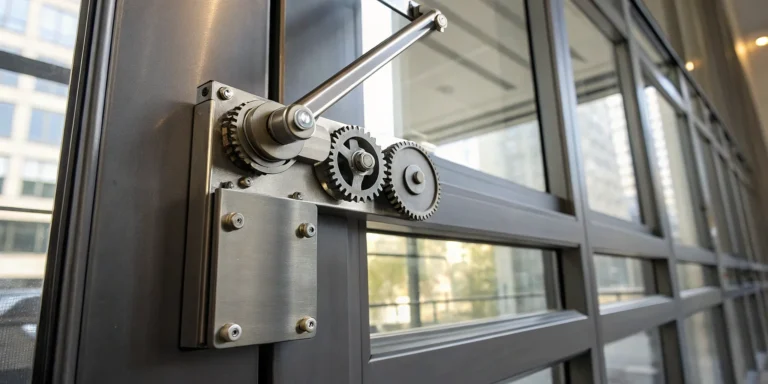
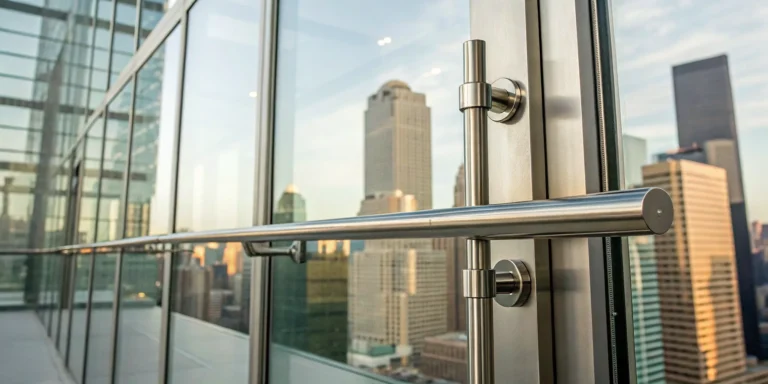
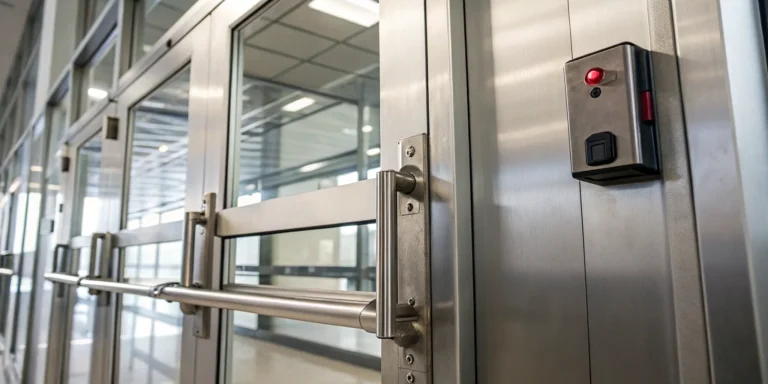
The push bar door lock mechanism — officially an exit device, commonly a panic bar or crash bar — is a spring-loaded horizontal bar that retracts the door’s latch when you press anywhere along it. Pushing the bar pulls the latch bolt out of the strike on the frame, so the door opens with one motion, no twisting or grabbing. From the inside it can never be locked — that’s the legal point of it. “Locking” a push bar door means one of two things: securing the outside with the trim cylinder so nobody can enter, or dogging the bar down so the door works as a plain push/pull during business hours. Both are covered below, along with the part names, the four device types, and the failures we’re called to fix.
The parts of a push bar mechanism, named
- Touchpad or crossbar — the part you push. Older devices use a full-width pivoting crossbar; modern ones use a flat touchpad that depresses into the housing.
- Chassis and end case — the housing at the latch end that contains the spring and linkage, and the cap at the hinge end. The chassis is where most internal wear happens.
- Latch bolt and strike — the angled bolt that holds the door shut, and the plate on the frame it seats into. On rim devices the latch lives in the chassis itself.
- Vertical rods and top/bottom latches — on rod-type devices, steel rods run from the chassis up to a latch at the frame head and down to one at the floor. These are the “lock rods” — more on them next.
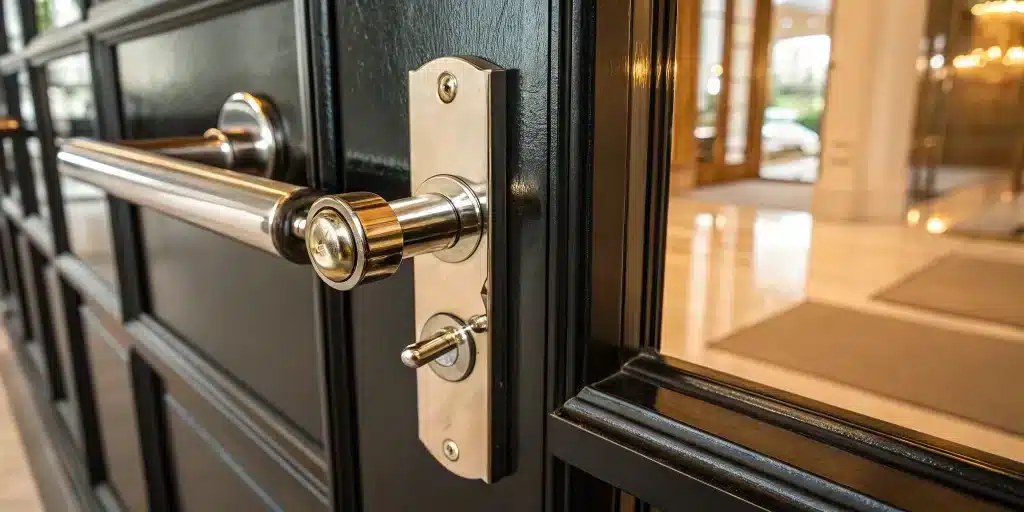
- Outside trim — the lever, pull, or plain plate on the exterior side, usually with a key cylinder. This is what controls entry from outside.
- Dogging mechanism — a small hex-key or key-cylinder fitting on the underside of the bar that holds the latch retracted.
Lock rods and push bars: how vertical-rod devices work
On a vertical-rod exit device, pressing the bar doesn’t retract a side latch — it pulls the top and bottom rods simultaneously, releasing a latch at the head of the frame and another at the floor. This is the standard setup on double doors, where there’s no fixed frame edge between the leaves for a rim latch to grab, and on doors that need locking points at top and bottom for security. Rods come surface-mounted (visible on the door face, easier to install and service) or concealed (hidden inside the door for a clean look — common in offices, hotels, and storefronts).
Rod devices are also the most failure-prone type, for a mechanical reason: the two rods must release and re-latch in exact sync. When a building settles, a door sags, or a floor latch fills with grit, the rods go “out of time” — one latch releases before the other, the bar needs a hard shove, or the door won’t re-latch at the top and swings unsecured. Re-timing the rods is an adjustment job, not a replacement, if it’s caught early.
The four device types (and which doors they belong on)
- Rim — surface-mounted, latch in the chassis, engages a strike on the frame face. The workhorse on single exit doors in restaurants, retail, and back-of-house. Simplest to install and maintain.
- Surface vertical rod — rods on the door face, top and bottom latching. Standard on pairs of doors and anywhere a rim strike can’t mount.
- Concealed vertical rod — same latching, rods hidden inside the door or the glass-door rail. What you’ll see on aluminum storefront and herculite glass doors across Manhattan retail.
- Mortise — a full mortise lock case set into the door edge, driven by the bar. The heaviest-duty option, specified for high-traffic and high-abuse openings like schools and hospital corridors.
Brand-wise, most of what we service in NYC is Von Duprin (the 98/99 series above all), Falcon, Yale, and — on narrow-stile aluminum storefront doors — Adams Rite. Parts availability for these is good, which matters when a repair beats a replacement.
How to lock and unlock a push bar door
From the outside: the key cylinder in the outside trim locks and unlocks entry. Locking the trim never affects exit — inside, the bar always opens the door. If the key turns but the lever stays dead, the trim’s tailpiece or cylinder cam has failed, not the bar.
Holding it open for business hours (dogging): insert the hex key (usually a 1/4″ Allen key) into the dogging port on the underside of the bar, press the bar down fully, and turn — the latch stays retracted and the door becomes a simple push/pull. Reverse it at closing time so the door latches again. Higher-spec devices use a key cylinder instead of a hex key for dogging. One critical exception: fire-rated exit devices have no dogging — a fire door must positively latch, always, so if your door is a rated one and the bar has a dogging port, someone installed the wrong hardware. Our full walkthrough with photos is in the guide to how to lock a push bar door.
What never to do: no chains, padlocks, slide bolts, or wedges on a door with panic hardware — in NYC that’s a Fire Code violation that shows up in FDNY inspections, and it turns your exit into a trap.
When the mechanism fails: symptom → cause
- Bar feels mushy or doesn’t spring back: the return spring or linkage in the chassis is worn. Repairable on quality devices; on budget hardware this is usually the end of its life.
- Bar depresses but the latch doesn’t retract: the linkage between touchpad and latch has disconnected or stripped — the dangerous failure, because the door may not open under pressure. Take it out of service and fix it same-day.
- Door won’t latch shut: on rim devices, the strike is misaligned (buildings settle, doors sag); on rod devices, the rods are out of time or the floor latch is fouled with debris. Both are adjustments, not replacements.
- Sticky or slow bar: dirt and dried lubricant in the chassis. Clean and re-lubricate before anything is replaced.
- Outside key won’t operate the trim: cylinder or tailpiece failure — the cylinder can usually be swapped or rekeyed without touching the bar.
A dragging or non-latching exit device is a code violation waiting for an inspection as well as a safety hazard. Our commercial door service repairs, re-times, and replaces exit devices across NYC, and we carry Von Duprin and Adams Rite parts on the truck.
The NYC part: where push bars are required
- Occupancy rules. The NYC Building Code requires panic hardware on egress doors serving assembly and educational spaces once occupant loads pass the code threshold — restaurants, bars, theaters, schools, houses of worship. If your certificate of occupancy says assembly, assume your exits need it.
- Fire-rated openings. Rated doors need fire exit hardware — panic devices listed for fire doors, with no dogging and positive latching. Swapping in a standard device on a rated door fails inspection.
- Accessibility. Exit hardware must operate with one hand, without tight grasping or twisting, and with modest force — which a properly maintained push bar satisfies and a sticking one doesn’t.
- Inspections. FDNY inspections check that exit doors open with a single motion and self-latch. The two violations we’re called about most: doors dogged open on rated openings, and bottom rod latches that no longer reach the floor strike.
When to call us
Call when the bar depresses but the door doesn’t open, when a double door won’t re-latch at the top, when you need a device dogged, re-timed, or replaced, or when an inspection flagged your exit hardware. We diagnose on site and quote a flat price before work starts. Golden Key Locksmith — licensed (DCWP #2065742-DCA), at 328 Columbus Ave since 1984. Call (212) 204-1655, 24/7.
Frequently asked questions
How do you lock a push bar door?
From the outside, with the key cylinder in the exterior trim. From the inside, you don’t — panic hardware must always allow free exit. If the bar is dogged down (held retracted for push/pull use), un-dog it with the hex key so the latch engages again; that’s what most people mean by “locking” the bar at closing time.
How do you lock a push bar door with an Allen key?
That’s the dogging feature, and it’s the reverse of locking: press the bar fully down, insert the hex key in the port on the underside, and turn to hold the latch retracted (door unlocked, push/pull). Turn it back and release the bar to re-latch the door. Fire-rated devices don’t have this port by design.
How do you unlock a push bar door from the outside?
Use the key in the outside trim to retract the latch or free the lever. If there’s no outside trim at all — common on exit-only doors — the door is not meant to be entered from outside, and the only correct change is having a locksmith add keyed trim, not modifying the bar.
What is the push bar on a door called?
An exit device is the industry term; panic bar, crash bar, and push bar all refer to the same hardware. On fire-rated doors the correct listed version is called fire exit hardware.
What are the lock rods on a push bar?
The vertical rods that run from the bar’s chassis to latches at the top of the frame and at the floor. They give the door two locking points instead of a side latch — standard on double doors — and when one rod falls out of sync with the other, the door either won’t open cleanly or won’t re-latch.
Why won’t my push bar door lock or latch shut?
Nine times out of ten it’s alignment, not the bar: the strike has drifted from the latch as the door sagged, or on rod devices the top and bottom latches are out of time. Both are adjustable. If the latch itself won’t extend even with the door open, the chassis linkage is the fault and needs repair.