Skip to content

Written by Steven Grunstein, lead locksmith at Golden Key Locksmith NYC (DCWP License #2065742-DCA), 328 Columbus Ave, Manhattan — operating since 1984.
Need commercial locks installed, repaired, or brought up to NYC fire and egress code? See our NYC commercial locksmith service.
The seven primary commercial door lock types used across NYC businesses are heavy-duty cylindrical levers, commercial mortise locksets, panic bars and exit devices, commercial deadbolts and storefront deadlatches, electronic access control systems, electromagnetic locks (maglocks), and interchangeable-core (SFIC/LFIC) high-security cylinders. Matching the right lock to your door material, traffic volume, and FDNY egress rules prevents hardware failure and code violations.
7 commercial door lock types compared for NYC properties
Every commercial entrance in New York City faces a different mix of door construction (hollow metal, wood fire-rated, or narrow-stile aluminum and glass), daily foot traffic, and life-safety compliance. Use this matrix to match each opening to the right lock family:
| Commercial Lock Type | Compatible Door Types | Traffic & Security Strength | NYC Code & Egress Notes | Best Business Applications |
|---|---|---|---|---|
| 1. Cylindrical Lever Lock (Grade 1) | Hollow metal and solid-core wood doors (standard 2-1/8″ bore) | High — 800,000+ cycles; clutching levers resist torque | ADA-compliant lever operation; free inside egress functions available | Office suites, conference rooms, clinics, classrooms, and interior corridors |
| 2. Commercial Mortise Lockset | Heavy wood and reinforced hollow-metal doors (mortise pocket cutout) | Very High — integrated latch + 1″ deadbolt in heavy steel case | Single-motion inside lever retracts both latch and deadbolt simultaneously (critical for NYC egress) | Main office entrances, hotel/co-op corridors, fire-rated stairwells, and pre-war commercial doors |
| 3. Panic Bar / Exit Device | Outward-swinging steel, wood, or aluminum-glass exit doors | High — Grade 1 rim, vertical-rod, or mortise exit chassis | Required by NYC Building Code / FDNY on high-occupancy exits (50+ occupants); UL-listed fire exit hardware required on fire doors | Retail stores, restaurants, theaters, schools, lobbies, and stairwell exits |
| 4. Commercial Deadbolt & Storefront Deadlatch | Deadbolts on steel/wood; Adams Rite deadlatches & hookbolts on narrow aluminum-glass | High — Grade 1 1″ hardened bolt or laminated hookbolt | Never use double-cylinder (key-inside) deadbolts on occupied commercial exits; storefront thumbturns/paddles must allow clear egress | Aluminum-glass retail storefronts, rear delivery doors, stockrooms, and service cages |
| 5. Electronic Access Control (Card / Fob / Keypad) | Almost any commercial door via electric strike, electrified lever/mortise, or smart reader | High — instant credential revocation, time schedules, and entry logs | Must preserve free mechanical egress or integrate with fire-alarm release | Multi-employee offices, coworking spaces, medical practices, gyms, and commercial lobbies |
| 6. Electromagnetic Lock (Maglock) | Frameless glass (herculite), aluminum storefronts, and double doors | High holding force (600–1,200 lbs) with zero moving latch parts | Fail-safe by design; NYC code mandates REX motion sensor, labeled push-to-exit button, and fire-alarm tie-in | Glass corporate lobbies, double vestibule entrances, and interior secure suites |
| 7. SFIC / High-Security Cylinder Systems | Retrofits into cylindrical, mortise, exit trim, storefront, and padlock hardware | Highest key control — UL 437 pick/drill resistance + restricted keyways | Preserves existing UL door labels while upgrading key security and rapid rekeying | Multi-tenant commercial floors, retail chains, pharmacies, and high-turnover facilities |
Deep dive: choosing among the 7 commercial lock types
1. Heavy-duty cylindrical lever locks
Cylindrical locks mount through a standard round bore hole and use a spring-loaded tubular latch. Always specify ANSI/BHMA Grade 1 (such as Schlage ND or Sargent 10X) for commercial entrances rather than residential hardware. Choose the right mechanical function — classroom, storeroom (always locked outside, free exit inside), or office — so staff cannot accidentally leave exterior doors unlocked.
2. Commercial mortise locksets
A mortise lock sits inside a rectangular pocket machined into the door edge, housing heavy steel springs, a strong anti-friction latchbolt, and an optional integrated 1-inch deadbolt inside one rugged body. On NYC commercial doors, a single-motion egress mortise function is unbeatable: turning the inside lever retracts both the latch and the deadbolt together in one step, delivering heavy security without violating fire-exit rules.
3. Panic bars and fire exit devices
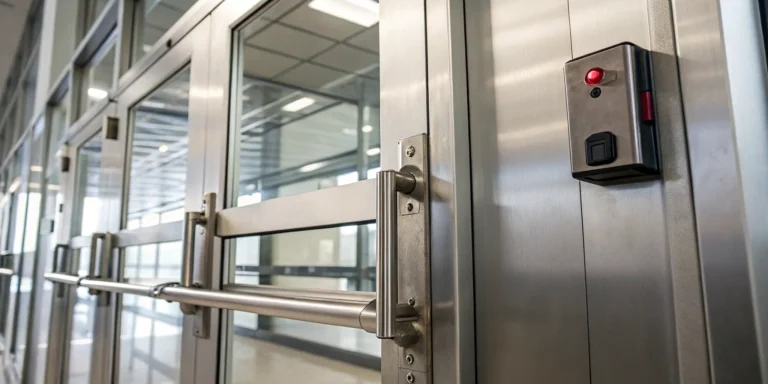
When an outward-swinging exit serves assembly spaces, busy retail floors, or high-occupancy offices, a UL-listed panic bar lets occupants exit with a single push requiring under 15 pounds of force. Choosing between rim, vertical-rod, and mortise exit devices depends on single vs. double doors and whether the door carries a fire label — see our NYC panic bar installation guide for full code details.
4. Commercial deadbolts and aluminum storefront locks
Standard tubular deadbolts work well on secondary steel storage doors, while NYC’s ubiquitous aluminum-and-glass storefronts rely on narrow-stile Adams Rite hardware: laminated hookbolts for overnight security paired with deadlatches and push paddles for daytime traffic. Upgrading the exposed mortise cylinder to a hardened Medeco or Mul-T-Lock cylinder with a tapered cylinder guard stops pipe-wrench twist attacks on street-level glass doors. For full storefront hardware and alignment work, see our NYC storefront door service.
5. Electronic access control (keycards, fobs, and keypads)
For businesses with growing teams, cleaners, and delivery windows, mechanical keys quickly become a liability. An electronic access control system uses proximity cards, key fobs, mobile credentials, or PIN pads tied to an electric strike or electrified mortise lock. You get scheduled lock/unlock hours, audit logs of every entry, and instant deactivation when an employee leaves — zero rekeying required.
6. Electromagnetic locks (maglocks)
Maglocks mount at the top header of frameless glass or double storefront doors where mechanical latches or strikes cannot fit cleanly. Because a maglock holds the door shut with electrical force rather than a latch, NYC fire code strictly requires three safeguards: a passive Request-to-Exit (REX) sensor, an accessible manual push-to-exit button that directly breaks lock power, and a tie-in to the building fire alarm so the door drops open automatically during an emergency.
7. Interchangeable-core (SFIC/LFIC) and high-security cylinders
Rather than replacing entire lock bodies across your space, upgrading the cylinder core to a patented restricted keyway (Medeco, Mul-T-Lock, ASSA ABLOY, Schlage Primus) or BEST SFIC platform stops unauthorized hardware-store key copies and makes future rekeying fast and predictable. Compare top cylinder and lock models in our review of five heavy-duty commercial door locks with key and five high-security lock brands for business.
NYC commercial compliance & hardware grades you cannot ignore
- ANSI/BHMA A156 Grades: Always use Grade 1 on exterior doors, lobbies, stairwells, and high-traffic suites (800,000–1,000,000+ cycles). Reserve Grade 2 (400,000 cycles) for low-traffic interior offices only; skip Grade 3 altogether in commercial spaces.
- ADA operability: Commercial doors must be operable with one hand without tight grasping, pinching, or twisting of the wrist — lever handles and push paddles meet ADA rules, whereas round doorknobs fail.
- Fire-door integrity: Fire-rated doors require UL-listed latches (never unlatched push/pull hardware), properly adjusted self-closing door closers, and zero unauthorized holes drilled into the door slab.
- Door and frame alignment: Even a top-rated commercial mortise lock will bind and wear prematurely if the hinges sag or the overhead closer slams. Address lock upgrades alongside commercial door and closer alignment.
Plan your NYC commercial lock upgrade with Golden Key
Every commercial space in NYC has a different mix of glass storefronts, steel rear exits, fire-rated stairwells, and interior offices. Steven Grunstein and our licensed team at Golden Key Locksmith NYC (328 Columbus Ave, Manhattan; DCWP License #2065742-DCA, operating since 1984) walk your property, identify code gaps and weak hardware, and give you a clear upfront quote before work begins. Visit our commercial locksmith page, our door repair & installation page, or call (212) 204-1655.
Frequently asked questions
Which commercial lock type is best for an NYC aluminum-and-glass storefront door?
Most narrow-stile aluminum storefronts use an Adams Rite laminated hookbolt (or deadlatch paired with an interior push paddle) fitted with a UL 437 high-security mortise cylinder and a free-spinning tapered cylinder guard to stop wrench attacks.
What is the difference between a cylindrical lock and a mortise lock?
A cylindrical lock mounts through standard round bore holes and houses its mechanism inside the lever chassis. A commercial mortise lock installs inside a rectangular pocket cut into the door edge, offering heavier internal components, longer service life, and combined latch-plus-deadbolt functions with single-motion inside egress.
Can I install a double-cylinder deadbolt on my shop’s back exit door?
No. Double-cylinder deadbolts that require a key to exit from the inside violate NYC Building Code and FDNY egress rules on occupied commercial spaces because they can trap staff or customers during a fire. Use a single-motion exit device, mortise egress lock, or alarmed panic bar instead.
When does electronic access control make more sense than mechanical commercial locks?
Electronic card, fob, or keypad access control makes more sense whenever you have frequent staff turnover, multiple shift schedules, delivery vendors, or a need for entry audit logs. Many NYC businesses install electronic access on the main entrance while keeping mechanical Grade 1 master-keyed hardware on interior offices.
How often should commercial door locks and closers be inspected?
High-traffic NYC storefronts and office entrances should be inspected at least once or twice a year — checking latch engagement, door closer sweep and latch speed, loose hinge screws, panic-bar unlatching force, and dry PTFE lubrication before minor wear turns into a jammed-door emergency.