How to remove a lever door handle depends on which of three fastening systems you have: a hidden spring catch on the neck of the lever (press it with a poke tool and pull), a small set screw (loosen it with an Allen wrench and slide the handle off), or a threaded mortise handle (unscrew it counter-clockwise like a bottle cap). Identify yours below and follow the matching steps. The job takes five minutes when it goes right — and in NYC apartments, where decades of paint layers hold hardware in place, we’ll also cover what to do when it doesn’t.
Before you start
The “Doorstop” Rule: Always prop the door open with a heavy stop before removing any handles. If the latch fails or the wind blows the door shut while the handle is removed, you will be locked out.
Fire Door Compliance (NYC Specific): In NYC commercial and multi-family buildings, many lever handles are part of a fire-rated assembly. If your door has a ‘Fire Door’ label on the hinge edge, you must replace components with ‘F’ rated hardware to remain code-compliant.
Tools: a small flathead screwdriver or paperclip (for hidden catches), a 3/32 and 1/8 inch Allen wrench set (for set screws), a Phillips screwdriver (for rose plate screws), and a utility knife (for paint seals on older doors).
How to remove a door lever handle: 3 NYC scenarios
Lever handles aren’t “one size fits all.” Identify your specific hardware from the three common NYC scenarios below.
Scenario A: The “Hidden Catch” (Standard Tubular)
Identify it: Look for a tiny slot or hole on the neck of the lever.
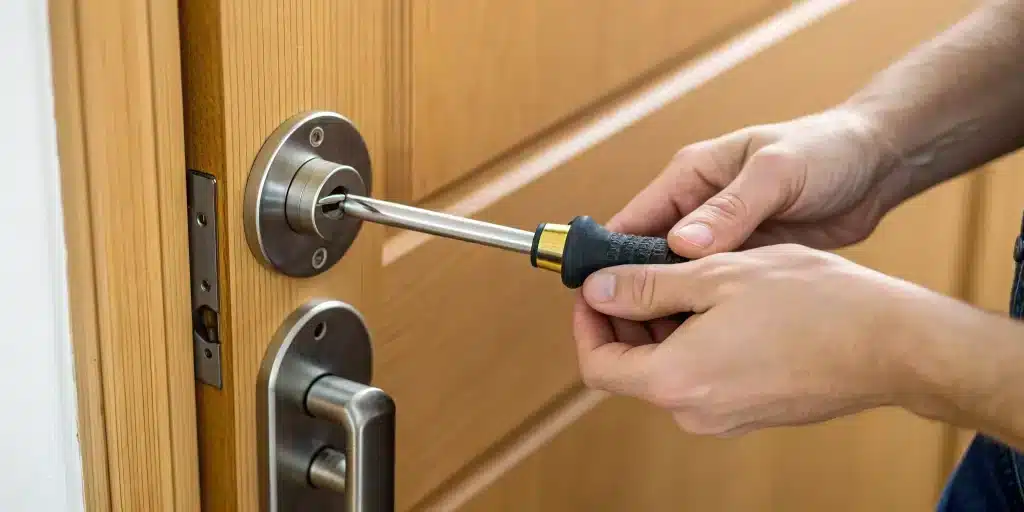
The Technique: Insert a small flathead screwdriver, paperclip, or the specialized ‘poke tool’ included with new locks. Push the spring-loaded detent in while pulling the handle off.
Scenario B: The Set Screw (Modern & Commercial)
Identify it: Look for a small hexagonal hole on the side or bottom of the lever.
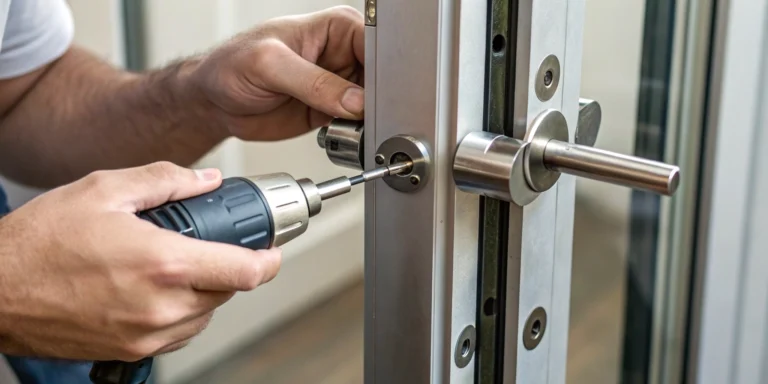
The Technique: Use a 3/32 or 1/8 inch Allen wrench (hex key). Loosen the screw (you often don’t need to remove it fully) until the handle slides off.
Scenario C: The Mortise Lever (Pre-War / NYC Apartments)
Identify it: A large rectangular plate on the door edge and a thumbturn above the handle.
The Technique: These handles are often threaded directly onto a spindle. You may need to loosen a tiny set screw on the knob’s neck, then unscrew the entire handle counter-clockwise like a bottle cap.
After the lever is off: the rose plate and lock body
With the handle removed, you’ll usually find a decorative rose plate against the door. If it has visible screws, remove them with a Phillips screwdriver; if not, look for a small notch on its rim and gently pop it off with a flathead to expose the two through-bolts holding the assembly together. Remove those bolts, pull both halves of the handle set away from the door, and back out the two faceplate screws on the door edge to slide the latch out. Keep the screws sorted by where they came from — mixed-up fasteners are the most common reassembly headache. If the lever was removed because it drooped or flopped rather than for replacement, the spring cassette inside is usually the culprit — see our guide to fixing a floppy door handle before buying new hardware.
Removing a lever door handle with a lock
Keyed levers (entry function) remove the same way as the scenarios above — the hidden catch or set screw is simply on the lever’s neck behind the lock cylinder, and the cylinder comes off with the outside handle. Two cautions: work with the door propped open so a locked latch can’t shut you out, and don’t disassemble the cylinder itself. If the reason for removal is a failed lock rather than a hardware swap, removal won’t fix the mechanism — that’s lock repair territory.
Identifying your NYC door handle type
Mortise Levers: Common in pre-war buildings on the Upper West Side and Brooklyn brownstones. These operate a heavy-duty lock body inside the door.
Interconnected Levers: Frequently found in NYC apartment complexes (StuyTown, Co-op City). When you turn the lever from the inside, it automatically unlocks the deadbolt for rapid exit (panic proof).
Return-to-Door Levers: Required by NYC code for commercial hallways to prevent fire hoses or clothing from snagging on the handle tip.
Stuck handle? The usual NYC culprits
If the screws are out and the handle still won’t budge, it’s almost always paint: score around the rose plate edge with a utility knife to break the seal before pulling — never pry against the door surface with a screwdriver. A handle seized on its spindle responds to gentle back-and-forth wiggling while pulling straight out. Stripped set screws need a slightly larger Allen key tapped in for grip, or a locksmith’s extractor. And if the lever belongs to a fire-rated or interconnected assembly, or the lock body itself has failed, stop — forcing these damages hardware that’s expensive to replace and, on fire doors, legally required to be correct.
When to call a professional
Call rather than continue if the handle is on a fire-rated door, the hardware is a pre-war mortise set you don’t want to damage, a set screw has stripped beyond grip, or removal was step one of a repair that turns out to be inside the lock body. Our team handles lever hardware, mortise locks, and full door repair and installation across NYC. We’re a licensed NYC locksmith (DCA #2065742) based at 328 Columbus Ave on the Upper West Side, available 24/7. Call (212) 204-1655.
Frequently Asked Questions
Why won’t my door handle come off even after removing the screws? If the screws are out but the handle is stuck, it’s likely painted shut—a common issue in older NYC apartments. Score the edge of the rosette (the round plate) with a utility knife to break the paint seal. Do not pry with a screwdriver, or you will damage the door surface.
Can I replace a mortise lever with a regular standard lever? No. Mortise locks require a large rectangular pocket inside the door, while standard ‘tubular’ levers use a simple round bore hole. Switching from mortise to standard usually requires replacing the entire door or installing a specialized ‘wrap-around’ remodeling plate to cover the holes.
How do I remove a lever door handle with hidden screws? “Hidden screws” almost always means a hidden catch: find the small slot or hole on the lever’s neck, press the spring-loaded detent inside with a paperclip or poke tool, and pull the handle off. If there’s no hole, check the underside for a recessed hex set screw.