Skip to content

Written by Steven Grunstein, lead locksmith at Golden Key Locksmith NYC (DCWP License #2065742-DCA), 328 Columbus Ave, Manhattan — operating since 1984.
Upgrading an NYC apartment, brownstone, or office door to keyless handle hardware? Explore our keypad access control systems, key fob entry systems, and NYC smart lock installation service.
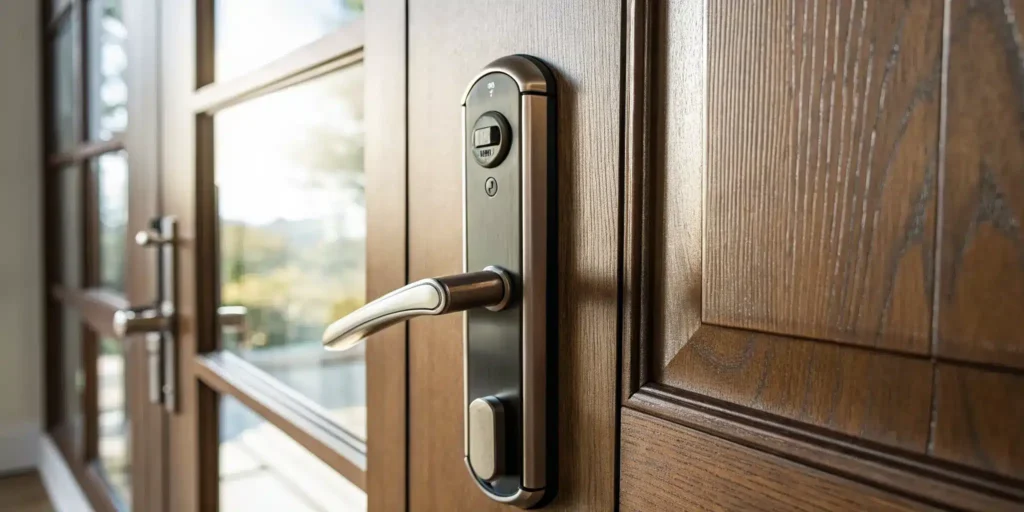
A keyless entry door lock with handle replaces traditional keyed knobs or levers with a PIN keypad, RFID key fob reader, or smart app/fingerprint lever in a single chassis. For NYC apartments and commercial offices, the right model must combine ANSI/BHMA Grade 1 or Grade 2 durability, single-motion interior egress, and a mechanical keyway or backup power override.
Keypad vs. key fob/card vs. smart handle locks compared
Not every keyless handle fits every door. A home-office interior door has very different traffic, security, and NYC code demands than a 40-person Manhattan suite entrance or an exterior townhouse entry.
| Keyless Handle Type | Primary Credential | User Turnover & Revocation | Duty Grade & Durability | Power & Override | Best NYC Residential / Office Fit |
|---|---|---|---|---|---|
| Standalone Mechanical or Battery Keypad Lever (e.g., Schlage FE595, Alarm Lock Trilogy DL2700/DL2800) | 4- to 6-digit PIN code | Manual delete/reprogram at the lock (or audit-trail cable on commercial units) | ANSI/BHMA Grade 2 (residential) up to heavy-duty Grade 1 (commercial) | AA batteries (years of life) or zero-battery mechanical push-button + physical key override | Interior offices, supply rooms, medical suites, back doors, and brownstone side entries |
| Key Fob / Proximity Card Lever (e.g., Alarm Lock PDL series, Schlage AD/NDE, standalone RFID) | Encrypted RFID fob, keycard, or mobile BLE credential | Instant revocation of lost/former staff fobs without changing codes for everyone else | Commercial ANSI/BHMA Grade 1 heavy-duty clutch lever | AA batteries or hardwired low-voltage power + SFIC/standard cylinder override | Multi-employee NYC offices, clinics, coworking suites, and shared building amenities |
| Smart Wi-Fi / Bluetooth Handle Lock (e.g., Yale Assure Lever, Schlage Encode Lever, Ultraloq Lever) | PIN code, smartphone app, NFC, or fingerprint | Remote instant add/delete, time-window guest codes, and real-time entry logs | Typically ANSI/BHMA Grade 2 (best for residential & light commercial traffic) | AA batteries + 9V/USB-C jump terminal and/or physical key cylinder | NYC apartments (where permitted), private offices, short-term rentals, and townhouse entries |
Keyless lever vs. deadbolt: a critical security distinction
Before installing a keyless handle on an exterior entry door, understand the difference between a spring latch and a deadbolt. Most keyless lever sets lock the exterior handle clutch while securing the door with a 1/2″ deadlocking latchbolt — not a full 1″ hardened steel deadbolt throw.
- Where a keyless lever alone is ideal: Office suite doors, interior storage rooms, medical exam rooms, property-management closets, and secondary doors behind a staffed lobby or intercom vestibule.
- Where you still need a deadbolt: Street-facing brownstone front doors, basement doors, and primary apartment entry doors. On exterior residential doors, pair a keyed/keyless deadbolt with a passage handle, or install an interconnected/mortise keyless assembly engineered for primary entry security.
- Always insist on a deadlocking latchbolt (guard bolt): A proper exterior-rated keyless lever includes a small secondary plunger beside the main latch that blocks credit-card or shim attacks once the door closes cleanly into the strike plate.
Hardware specifications to verify before buying a keyless handle
Checking five physical measurements and hardware ratings prevents returns and premature wear:
| Specification | What to Check | Why It Matters in NYC Doors |
|---|---|---|
| ANSI/BHMA Security Grade | Grade 1 (heavy commercial) vs. Grade 2 (light commercial / solid residential) | Grade 3 builder-grade handles wear out quickly under daily city traffic and lack clutch protection against lever torque attacks |
| Clutch / Free-Wheeling Lever | Exterior lever rotates freely when locked instead of hitting a rigid stop | Prevents vandals or force from snapping internal lock components by hanging weight on the handle |
| Door Thickness & Backset | Standard 1-3/8″–1-3/4″ thick; 2-3/8″ or 2-3/4″ backset; cylindrical vs. mortise prep | Many pre-war NYC steel and fire doors exceed 1-3/4″ or use mortise bodies that cannot accept standard cylindrical levers without conversion |
| UL Fire Rating | UL 10C / 3-hour fire-rated steel latchbolt on corridor or stairwell doors | Required by NYC Building Code on fire-rated apartment entry doors and commercial hallway suites |
| Weather & Temperature Rating | IP54+ exterior gasket and lithium-battery tolerance for winter lows | Street-exposed vestibules and roof bulkheads see rain, salt air, and freezing temperatures that corrode indoor-only keypads |
NYC apartment and commercial office compliance rules
Installing keyless handle hardware in New York City carries strict life-safety and accessibility obligations that off-the-shelf big-box packaging rarely explains:
- Single-motion free egress (NYC Building Code & FDNY): Every occupied office suite, commercial room, and residential unit door must open from the inside with a single downward push of the lever — never requiring a PIN, key, fob, or secondary turnpiece to escape during an emergency.
- ADA lever compliance for commercial spaces: Offices, clinics, retail back-of-house doors, and public restrooms must use lever handles operable with a closed fist (no tight pinching, grasping, or twisting of a round knob).
- Co-op, condo, and landlord approval: In residential buildings, check house rules before altering corridor-facing trim. If your building forbids exterior keypads facing the hallway, consider a no-drill interior retrofit smart lock instead of replacing the outside lever.
- Master-key and SFIC integration: Commercial buildings frequently require a building superintendent or property manager master key to override office locks. Commercial keyless levers (such as Alarm Lock Trilogy or Schlage CO/AD/NDE series) accept standard mortise/KIK cylinders or SFIC interchangeable cores so your mechanical master key keeps working seamlessly.
Installation, power management, and maintenance tips
A properly installed keyless handle lasts years with minimal attention when you follow four simple rules:
- Check strike-plate alignment before tightening screws: The deadlocking guard bolt must rest against the flat strike plate face while the main latch enters the strike pocket cleanly. If both fall into the hole, the door becomes vulnerable to shimming.
- Use high-quality alkaline or lithium batteries: Change all batteries on a schedule (or immediately on low-battery chirp) and keep the physical override key stored securely outside the locked room — never inside the office or apartment it unlocks.
- Rotate shared PIN codes regularly: If you use a keypad lever for a team or service vendors, assign individual user codes whenever the lock supports multi-user slots so you can delete one departing person without retraining everyone else.
- Know when to step up to wired access control: Once a commercial office passes 15–20 staff members, needs scheduled unlock hours, or must tie into a building intercom/buzzer release, a dedicated hardwired access control system or key fob entry system delivers far better reliability than battery-powered residential levers.
Work with Golden Key Locksmith NYC
Choosing between a residential smart lever, a Grade 1 commercial keypad, or a key-fob access handle comes down to your exact door construction, traffic level, and building code rules. Steven Grunstein and our licensed locksmiths at Golden Key Locksmith NYC (DCWP License #2065742-DCA, 328 Columbus Ave, Manhattan — operating since 1984) supply, prep, and install commercial and residential keyless handles across all five boroughs, with clear upfront quotes and master-key integration. Explore our keypad access control systems, key fob entry systems, NYC smart lock installation service, or call (212) 204-1655.
Frequently asked questions
Are keyless entry door lock handles secure enough for a front entry door?
A keyless lever alone secures the door with a 1/2″ spring-driven latchbolt, which is ideal for interior offices, clinics, and secured lobby suites. For a street-facing NYC home or apartment entry door, pair a Grade 1 or Grade 2 keyless deadbolt with a passage lever, or choose a mortise/interconnected keyless assembly.
What happens if the battery dies in a keyless door handle?
Commercial and residential keyless levers give weeks of low-battery warnings before failing. If batteries die completely, unlock the door with the mechanical override key cylinder, or apply a 9V battery / USB-C power bank to the exterior emergency power terminals on key-free models.
Can a keyless handle work with my building’s master key?
Yes, if you select a commercial keyless lever (such as Alarm Lock Trilogy or Schlage commercial series) that accepts standard KIK or SFIC cylinders. Your locksmith pins the override cylinder to your existing building master keyway so management retains emergency entry.
Which is better for a busy NYC office: a keypad handle or a key fob handle?
Key fob and smart-card handles are better for offices with frequent staff turnover or shared suites because you can deactivate a single lost or former-employee fob without changing a shared PIN. Keypad handles work best for small teams, storage rooms, and maintenance doors where carrying fobs is inconvenient.
Can I install a keyless lever on a fire-rated NYC apartment or office door?
Only if the lockset is UL-listed for fire doors, uses a steel self-latching bolt, provides single-motion interior egress, and installs without violating the door’s fire label. A licensed commercial locksmith should inspect fire-rated doors before modifying any cutout.